I'm not going to offer excuses (though I could), but I need to fess up here that I failed to get a LARP organized by the end of August. Which sucks, but I still want to try for future months. Possibly the work on the Poking the Emperor game will be used for September or November. (October is spoken for already.)
September may or may not be preempted by Game Chef 2009, the annual roleplaying game design competition. Though this year it's not really a competition, any more than NaNoWriMo is.
In the meantime, readers should check out Game Chef, too. Make your own game, or read other people's attempts to make games. When things are finished, read some of the rough draft games that get made, and find one that you love. Playtest things. Have fun.
You can follow my Game Chefing exploits over on the blog made for that purpose. If this keeps up, I'll just have a blog for every topic I ever write about.
Monday, August 31, 2009

Saturday, August 1, 2009
More complete LARP report
The French and Indian War started last night.
If anything, the most surprising thing is how close the results were to real history. Jumonville died while trying to talk to George Washington, and battles broke out so eventually the French and British empires would come in conflict.
It was also surprising how many people achieved their goals. Basically everyone, I think, including the deceased Jumonville.
Maybe I should start at the beginning. It will almost certainly help if you read the character information.
First off, the game was based off of, but heavily modified from, The Bloody Forks of the Ohio by Jason Morningstar. I had to modify a lot of it to fit more the sort of LARP I was trying to run, but it still provided an awesome situation and set of characters to play. I took that game, stripped off the system, modified the characters somewhat and made a more specific situation. In the process I sometimes got another step or two away from real history, though some additional internet history helped keep things close-ish to what really happened.
We had seven players, two GMs:
Steve played George Washington,
Geoff played William Trent,
Stacie played "French Margaret" Montour,
Adam played Shingas the Terrible,
Matthew played Half-King Tanaghrisson,
Wendy played Marie-Amable Prudhomme de Villiers
and Russell played Joseph Coulon de Jumonville.
Amber and I GMed. Jacob Van Braam, Torrence Swiney, Captain Pipe Hopocan, and Raspberry Girl all were sadly unplayed. Raspberry Girl and Ignatius Jones remained important as NPCs, though, as the relationship between the British and the Delaware was a key point in the game.
Language played a key role in the game (as in real history): some characters only spoke English, some only spoke French. All the native americans spoke Shawnee (in addition to their own nation's language). Many characters spoke two or more languages. But this meant that some of the key players could not talk to one another: Jumonville only spoke French, Washington only English. Shingas the Terrible and Washington would determine jointly if the Delware would work with Britain, but did not share a language. They all needed the assistance of translators to communicate. This was all handled in the LARP by a series of hand signals: an upraised hand like Indians use in old bad movies meant you were speaking Shawnee, and a clenched fist meant you spoke in French. This actually worked really well, from what I saw.
Which brings up another point: there was a noticeable amount of player/character knowledge separation going on. Several characters had their most hidden secret right on their name badge for everyone to see (including the unplayed Torrence Swiney's awesome Key of "secretly a woman"). And everyone spoke in English, so you could tell if your character was dealing with an untrustworthy translator, even if your character could not.
Overall, the system used planned on there being more mechanical conflicts than there actually were. Very few people actually resorted to cards when they wanted to accomplish things. But there still was enough non-mechanical conflict going on that it wasn't really necessary.
The game opened with a French diplomatic delegation (Jumonville and Marie-Amable being guided by Shingas the Terrible) reaching Fort Necessity. Meanwhile inside, George Washington was formulating a plan for how to deal with the deserter Ignatius Jones. His planwas to free Jones and give him back to the Delaware, though Half-King delayed this plan. Half-King thought they could get more use out of him other ways... possibly by killing him.
Once the French met Washington, Jumonville did his best to piss of Washington, but mainly alienated his translators. Early in the game, he disowned his sister, meaning he had to trust interpreters from the British side. And he slapped Washington in the face and challenged him to a duel, though nothing came of that.
Some people got to scheming quickly, and had some interesting plans. Half-King had a plan to murder Ignatius Jones in the woods and make it look like the French killed him. This would hopefully cause the Delaware to ally with the British, and bring them closer to the Iroquois (also allied with the British). Half-King found and killed a French soldier, but then did not trust William Trent with getting Jones into the woods and killing him.
At some point early on Half-King found the French forces lying in wait while scouting the woods. So he told Washington of their presence. After some consideration, Washington determined that the French hiding in ambush at Deer Lake comprised most of the French forces in the region. Fort Duquesne, therefore, was nearly undefended. He formulated a plan (and later carried it out) to take his men, avoid the French and attack Fort Duquesne.
Somehow in the midst of scheming and being insulted in French, Washington found time to get it on with his French girlfriend. This later resulted in an anachronistic high-five between Washington and (I think) Half-King.
Shingas the Terrible turned out to be less terrible and less hateful of the British than one might have imagined. His secret love of French Margaret counted for more than his hatred of the Brits, I guess. He spent much of the game trying to get her away from the battle. Eventually, Shingas confessed his love to her (while escorting away a newly freed Ignatius Jones) in a touching sort of scene. French Margaret wasn't sure how to react, but eventually decided to go with Shingas at the end of the game, as the Delaware and Iroquois both got away from the fight between the British and the French. Ignatius Jones also gave Shingas a nice pep talk about how to make cross-cultural relationships work out.
William Trent wound up acting as de facto translator for Washington and Jumonville. I was a bit surprised that Washington would trust Trent that much, but Trent did try to undermine Washington in other ways. Trent was the one who fast-talked a guard into freeing IgnatiusJones, by telling him that the plan for secretly freeing Jones was Washington's special diplomacy move to help befriend the delware. The guard believed this, and that's actually what freeing Jones did do, but I think it's possible that at the time Trent was planning on murdering Jones. It's not clear to me when the "frame the French" plan was abandoned. In the end, Trent and a handful of men were left in Fort Necessity as a decoy, and sent to a fake rendezvous point while Washington went on to attack Fort Duquesne.
I'm a little unclear on some of what happened between the native tribes, but the freeing of Ignatius Jones (and possibly Shingas's secret love?) made the Delaware more willing to work with the Iroquois, so in the end they were working together and evacuating Fort Necessity together. I am also unsure what happened to Marie-Amable about two-thirds of the way through the game, but she apparently was escorted away to somewhere safe (Gist's outpost, I think, which shows I wasn't the only one doing my homework). The ten men who escorted her were chosen because they were the ten ugliest men in Washington's militia... I guess he didn't want any potential romantic rivals.
The game finally came to a climax when Washington was gathering his troops for evacuation, and Jumonville came up demanding in French to know what was going on. When he did not get an answer, Jumonville struck Washington in front of all the troops, who then attacked Jumonville. French Margaret decided to help the attack on her half-brother, so Jumonville was killed in the camp (thus ensuring the French and Indian War would start as history expected it to). Thereafter, Washington and the native nations left fort necessity, leaving just a skeleton crew with Trent to fool the French waiting nearby.
I'm sure that's only a fraction of what happened. And I'm sure it's also pretty fragmentary. It's hard to take all the strands of a LARP like this and make it into a coherent narrative; there is so much going on, and often I as GM don't know everything that is happening and/or why a character makes the choices that they do. But it hopefully gives some idea the sort of things that happened.
Everyone reportedly enjoyed themselves. The situation produced enough interaction to keep everyone entertained for about an hour and a half once we started playing. At the end, most conflicts were resolved and everyone got more-or-less what they wanted. I am personally pleased by how everything turned out. As always, I feared it could all fall apart at the last minute in some unexpected way. This time, at least, it didn't.
I think the game sparked some interest in the French and Indian War era among some of the players. At least one researched stuff ahead of time, and two or three others said afterwards that they were more interested in the timeframe because of the game. Being educational was a secondary goal at best. (I had a list of historical innacuracies, but stopped keeping track when it got too long.) But if it inspired a desire for learning, then that is pretty awesome, overall.
Things I Might Change If I Ran It Again:
Possibly make Half-King more antagonistic to the Delaware, and make the Delaware hate him more. Should have defined the Iroquois's tyranny of the delaware a bit better.
Focus less on the rules and conflict system, as it didn't come into play very much. Possibly make special abilities more useul, though if the conflict is never used then they're kinda irelevant.
Figure out better reasons for people to move around the larpspace. As it was, everything happened "in the fort" or "outside the fort" and later "far away from the fort". Two rooms I had defined went unused. I guess maybe I just didn't predict where characters would want to go. Should have had the bedroom be the fort's prison cell, instead of Washington's quarters.
None of those are major sticking points, though. The game was totally successful with those things as they were. And I'm not really sure what else I would want to change.
So there you have it. That was longer than I thought it would be, but a lot happened.
If anything, the most surprising thing is how close the results were to real history. Jumonville died while trying to talk to George Washington, and battles broke out so eventually the French and British empires would come in conflict.
It was also surprising how many people achieved their goals. Basically everyone, I think, including the deceased Jumonville.
Maybe I should start at the beginning. It will almost certainly help if you read the character information.
First off, the game was based off of, but heavily modified from, The Bloody Forks of the Ohio by Jason Morningstar. I had to modify a lot of it to fit more the sort of LARP I was trying to run, but it still provided an awesome situation and set of characters to play. I took that game, stripped off the system, modified the characters somewhat and made a more specific situation. In the process I sometimes got another step or two away from real history, though some additional internet history helped keep things close-ish to what really happened.
We had seven players, two GMs:
Steve played George Washington,
Geoff played William Trent,
Stacie played "French Margaret" Montour,
Adam played Shingas the Terrible,
Matthew played Half-King Tanaghrisson,
Wendy played Marie-Amable Prudhomme de Villiers
and Russell played Joseph Coulon de Jumonville.
Amber and I GMed. Jacob Van Braam, Torrence Swiney, Captain Pipe Hopocan, and Raspberry Girl all were sadly unplayed. Raspberry Girl and Ignatius Jones remained important as NPCs, though, as the relationship between the British and the Delaware was a key point in the game.
Language played a key role in the game (as in real history): some characters only spoke English, some only spoke French. All the native americans spoke Shawnee (in addition to their own nation's language). Many characters spoke two or more languages. But this meant that some of the key players could not talk to one another: Jumonville only spoke French, Washington only English. Shingas the Terrible and Washington would determine jointly if the Delware would work with Britain, but did not share a language. They all needed the assistance of translators to communicate. This was all handled in the LARP by a series of hand signals: an upraised hand like Indians use in old bad movies meant you were speaking Shawnee, and a clenched fist meant you spoke in French. This actually worked really well, from what I saw.
Which brings up another point: there was a noticeable amount of player/character knowledge separation going on. Several characters had their most hidden secret right on their name badge for everyone to see (including the unplayed Torrence Swiney's awesome Key of "secretly a woman"). And everyone spoke in English, so you could tell if your character was dealing with an untrustworthy translator, even if your character could not.
Overall, the system used planned on there being more mechanical conflicts than there actually were. Very few people actually resorted to cards when they wanted to accomplish things. But there still was enough non-mechanical conflict going on that it wasn't really necessary.
The game opened with a French diplomatic delegation (Jumonville and Marie-Amable being guided by Shingas the Terrible) reaching Fort Necessity. Meanwhile inside, George Washington was formulating a plan for how to deal with the deserter Ignatius Jones. His planwas to free Jones and give him back to the Delaware, though Half-King delayed this plan. Half-King thought they could get more use out of him other ways... possibly by killing him.
Once the French met Washington, Jumonville did his best to piss of Washington, but mainly alienated his translators. Early in the game, he disowned his sister, meaning he had to trust interpreters from the British side. And he slapped Washington in the face and challenged him to a duel, though nothing came of that.
Some people got to scheming quickly, and had some interesting plans. Half-King had a plan to murder Ignatius Jones in the woods and make it look like the French killed him. This would hopefully cause the Delaware to ally with the British, and bring them closer to the Iroquois (also allied with the British). Half-King found and killed a French soldier, but then did not trust William Trent with getting Jones into the woods and killing him.
At some point early on Half-King found the French forces lying in wait while scouting the woods. So he told Washington of their presence. After some consideration, Washington determined that the French hiding in ambush at Deer Lake comprised most of the French forces in the region. Fort Duquesne, therefore, was nearly undefended. He formulated a plan (and later carried it out) to take his men, avoid the French and attack Fort Duquesne.
Somehow in the midst of scheming and being insulted in French, Washington found time to get it on with his French girlfriend. This later resulted in an anachronistic high-five between Washington and (I think) Half-King.
Shingas the Terrible turned out to be less terrible and less hateful of the British than one might have imagined. His secret love of French Margaret counted for more than his hatred of the Brits, I guess. He spent much of the game trying to get her away from the battle. Eventually, Shingas confessed his love to her (while escorting away a newly freed Ignatius Jones) in a touching sort of scene. French Margaret wasn't sure how to react, but eventually decided to go with Shingas at the end of the game, as the Delaware and Iroquois both got away from the fight between the British and the French. Ignatius Jones also gave Shingas a nice pep talk about how to make cross-cultural relationships work out.
William Trent wound up acting as de facto translator for Washington and Jumonville. I was a bit surprised that Washington would trust Trent that much, but Trent did try to undermine Washington in other ways. Trent was the one who fast-talked a guard into freeing IgnatiusJones, by telling him that the plan for secretly freeing Jones was Washington's special diplomacy move to help befriend the delware. The guard believed this, and that's actually what freeing Jones did do, but I think it's possible that at the time Trent was planning on murdering Jones. It's not clear to me when the "frame the French" plan was abandoned. In the end, Trent and a handful of men were left in Fort Necessity as a decoy, and sent to a fake rendezvous point while Washington went on to attack Fort Duquesne.
I'm a little unclear on some of what happened between the native tribes, but the freeing of Ignatius Jones (and possibly Shingas's secret love?) made the Delaware more willing to work with the Iroquois, so in the end they were working together and evacuating Fort Necessity together. I am also unsure what happened to Marie-Amable about two-thirds of the way through the game, but she apparently was escorted away to somewhere safe (Gist's outpost, I think, which shows I wasn't the only one doing my homework). The ten men who escorted her were chosen because they were the ten ugliest men in Washington's militia... I guess he didn't want any potential romantic rivals.
The game finally came to a climax when Washington was gathering his troops for evacuation, and Jumonville came up demanding in French to know what was going on. When he did not get an answer, Jumonville struck Washington in front of all the troops, who then attacked Jumonville. French Margaret decided to help the attack on her half-brother, so Jumonville was killed in the camp (thus ensuring the French and Indian War would start as history expected it to). Thereafter, Washington and the native nations left fort necessity, leaving just a skeleton crew with Trent to fool the French waiting nearby.
I'm sure that's only a fraction of what happened. And I'm sure it's also pretty fragmentary. It's hard to take all the strands of a LARP like this and make it into a coherent narrative; there is so much going on, and often I as GM don't know everything that is happening and/or why a character makes the choices that they do. But it hopefully gives some idea the sort of things that happened.
Everyone reportedly enjoyed themselves. The situation produced enough interaction to keep everyone entertained for about an hour and a half once we started playing. At the end, most conflicts were resolved and everyone got more-or-less what they wanted. I am personally pleased by how everything turned out. As always, I feared it could all fall apart at the last minute in some unexpected way. This time, at least, it didn't.
I think the game sparked some interest in the French and Indian War era among some of the players. At least one researched stuff ahead of time, and two or three others said afterwards that they were more interested in the timeframe because of the game. Being educational was a secondary goal at best. (I had a list of historical innacuracies, but stopped keeping track when it got too long.) But if it inspired a desire for learning, then that is pretty awesome, overall.
Things I Might Change If I Ran It Again:
Possibly make Half-King more antagonistic to the Delaware, and make the Delaware hate him more. Should have defined the Iroquois's tyranny of the delaware a bit better.
Focus less on the rules and conflict system, as it didn't come into play very much. Possibly make special abilities more useul, though if the conflict is never used then they're kinda irelevant.
Figure out better reasons for people to move around the larpspace. As it was, everything happened "in the fort" or "outside the fort" and later "far away from the fort". Two rooms I had defined went unused. I guess maybe I just didn't predict where characters would want to go. Should have had the bedroom be the fort's prison cell, instead of Washington's quarters.
None of those are major sticking points, though. The game was totally successful with those things as they were. And I'm not really sure what else I would want to change.
So there you have it. That was longer than I thought it would be, but a lot happened.
LARP Last Night
Last night we had the "Bloody Forks of the Ohio" LARP. Everything went well. I'll try to write a full report after I get some food in me. Until then, you can peruse the LARP documents that are online.
Monday, July 20, 2009
I am currently stuck in the "two weeks until the LARP happens" slump, wherein I worry constantly if anyone will actually attend the thing. Right now there are all of 3 players RSVPed, which makes me wonder how small a group we need to play.
Now, this happens every month, and sometime in the remaining time the guest list expands, but I need to remind myself of this every single time. And I still try to adjust plans as it happens, in case we really do have a below average turnout.
something I noticed just now was that all the female characters in this game are about blending or bridging two distinct cultural groups, whereas the male roles all seem to be more certain about their place in the world. More definite in which group they belong in. I think that's sort of interesting, and worth milking for thematic value, if I can figure out how. It's sort of accidental, but it makes some sort of intuitive sense (especially when you look at the individual characters and the setting, rather than an abstract statement about gender).
Now, this happens every month, and sometime in the remaining time the guest list expands, but I need to remind myself of this every single time. And I still try to adjust plans as it happens, in case we really do have a below average turnout.
something I noticed just now was that all the female characters in this game are about blending or bridging two distinct cultural groups, whereas the male roles all seem to be more certain about their place in the world. More definite in which group they belong in. I think that's sort of interesting, and worth milking for thematic value, if I can figure out how. It's sort of accidental, but it makes some sort of intuitive sense (especially when you look at the individual characters and the setting, rather than an abstract statement about gender).
Tuesday, July 14, 2009
Adaptation instead of Originality
It's been a little while since I wrote here, largely because June and July have been really busy. But also because the monthly LARP project went on the back burner for a little while, what with Origins and Amber running the June game and such.
Regardless, I'm now at work on the July one. And what may be the August one at the same time, though that's a collaborative work that will be done whenever it gets done. July, though, is shaping up as an interesting project to write, because it feels different from other stuff I've done.
See, the previous games I wrote wholesale, whereas this one is being based off of a tabletop game written by Jason Morningstar. You might think that this would be easier, but it provides its own set of challenges. The analogy I told Amber was that if you write a novel from scratch, that has its own problems to overcome and issues to work ou: coming up with characters and plotting the thing and such. Now if you are hired to write a novel based off of a movie (or whatever), the characters and plot are already figured out for you. But that doesn't mean you're not writing a novel: it still requires you do a lot of work, just in solving different issues, such as how to translate from screen to text, how to make two hours of film last two hundred pages, and a lot of other decisions on how to adapt it into a new medium.
So for this game, I'm taking a game that lets the characters range all across 18th century Pennsylvania and constraining it down to a specific time and location. And I have to clarify the situation enough that players understand everything that they need to know just by reading their character sheet. And I need to research the actual historical events covered in the game, as the scenario by Morningstar doesn't quite explain what you need to know. I think that Jason assumed others had his level of historical knowledge, so I'm constantly having to learn more to really understand what's built into the game. And of course I need to simplify the characters mechanically, and come up with a LARP appropriate system to use.
So it presents a different set of challenges from previous games. I don't actually know how much those differences will translate into differences from a players perspective, though. On one level the game is still about different characters with secrets and conflicting motives stuck in a limited space until their conflicts escalate and resolve, like most other games I run. But we'll see if a couple innovations take hold, such as this being a (largely) non-fiction game, and a stronger emphasis on player/character separation.
Regardless, I'm now at work on the July one. And what may be the August one at the same time, though that's a collaborative work that will be done whenever it gets done. July, though, is shaping up as an interesting project to write, because it feels different from other stuff I've done.
See, the previous games I wrote wholesale, whereas this one is being based off of a tabletop game written by Jason Morningstar. You might think that this would be easier, but it provides its own set of challenges. The analogy I told Amber was that if you write a novel from scratch, that has its own problems to overcome and issues to work ou: coming up with characters and plotting the thing and such. Now if you are hired to write a novel based off of a movie (or whatever), the characters and plot are already figured out for you. But that doesn't mean you're not writing a novel: it still requires you do a lot of work, just in solving different issues, such as how to translate from screen to text, how to make two hours of film last two hundred pages, and a lot of other decisions on how to adapt it into a new medium.
So for this game, I'm taking a game that lets the characters range all across 18th century Pennsylvania and constraining it down to a specific time and location. And I have to clarify the situation enough that players understand everything that they need to know just by reading their character sheet. And I need to research the actual historical events covered in the game, as the scenario by Morningstar doesn't quite explain what you need to know. I think that Jason assumed others had his level of historical knowledge, so I'm constantly having to learn more to really understand what's built into the game. And of course I need to simplify the characters mechanically, and come up with a LARP appropriate system to use.
So it presents a different set of challenges from previous games. I don't actually know how much those differences will translate into differences from a players perspective, though. On one level the game is still about different characters with secrets and conflicting motives stuck in a limited space until their conflicts escalate and resolve, like most other games I run. But we'll see if a couple innovations take hold, such as this being a (largely) non-fiction game, and a stronger emphasis on player/character separation.
Tuesday, June 16, 2009
Multithreaded
Because my 30th birthday was the other day, Amber decided to take over the larpwright duties for the month. This is good, as it gives me a break just around when GM burnout was setting in. And it means some vague, secretive plans are being made all around me, though that is more "mysterious" and "worrying" than it is clearly good.
But it leaves me in a position of not having a project to work on right now. I am communicating with Ross regarding the July event, but that's slow going. July's game is a long way away, and the planning is all via email (which slows the sharing of ideas), and I feel like I overrode Ross's input a bit much in the Western game we collaborated on. So I don't want to bound too far ahead of his input by writing more stuff (though I fear this may be happening regardless).
So this leaves me with no LARPs to be writing right now, just as the habit had formed. My solution at this point is to create a couple of outlines for future games, which will get fleshed out in the remaining months before the games are actually needed. This is good, since it provides a creative outlet and such. And it means I'll have preplanned ideas for in the future when people ask what's up for future months.
Now, depending on how things play out, some of these ideas might not get actually used. Any assistant GMs I have may wind up disliking the available list of potential LARPs, and we'll opt to write and play something entirely new. And at this point it looks like I have one more LARP idea than there are remaining months in the year. And, of course, more ideas will come in the next six months as well. So some of these ideas won't get played. At least, not as part of the monthly LARP project.
Some readers may think "Hey, you could continue the monthly LARP series into 2010!" But that's crazy talk. By next January, I'll need a good break from doing this. And I'll probably find some other creative outlet at that point. But part of the point of this (in my mind, anyway) is the limited scope: you write twelve games, run them, think critically about what happened, then move on with that information.
I'm sure more LARPs will happen in the future. But one a month is a difficult rate for me to keep up. Which is why I challenged myself to do so int he first place.
But it leaves me in a position of not having a project to work on right now. I am communicating with Ross regarding the July event, but that's slow going. July's game is a long way away, and the planning is all via email (which slows the sharing of ideas), and I feel like I overrode Ross's input a bit much in the Western game we collaborated on. So I don't want to bound too far ahead of his input by writing more stuff (though I fear this may be happening regardless).
So this leaves me with no LARPs to be writing right now, just as the habit had formed. My solution at this point is to create a couple of outlines for future games, which will get fleshed out in the remaining months before the games are actually needed. This is good, since it provides a creative outlet and such. And it means I'll have preplanned ideas for in the future when people ask what's up for future months.
Now, depending on how things play out, some of these ideas might not get actually used. Any assistant GMs I have may wind up disliking the available list of potential LARPs, and we'll opt to write and play something entirely new. And at this point it looks like I have one more LARP idea than there are remaining months in the year. And, of course, more ideas will come in the next six months as well. So some of these ideas won't get played. At least, not as part of the monthly LARP project.
Some readers may think "Hey, you could continue the monthly LARP series into 2010!" But that's crazy talk. By next January, I'll need a good break from doing this. And I'll probably find some other creative outlet at that point. But part of the point of this (in my mind, anyway) is the limited scope: you write twelve games, run them, think critically about what happened, then move on with that information.
I'm sure more LARPs will happen in the future. But one a month is a difficult rate for me to keep up. Which is why I challenged myself to do so int he first place.
Wednesday, June 3, 2009
Tabletop Play, Inverted
Something has been growing clear to me as I run a series of LARPs each month. It has to do with power relationships between the players and the GM. But first I'll have to talk for a while about tabletop RPGs, before circling back to my monthly larps.
You see, LARPing is really a secondary hobby for me, despite it currently taking up a decent amount of my time over the last few months. The majority of my roleplaying historically and preferentially takes the form of "tabletop" roleplaying (if you're a larper) or "pen and paper" roleplaying (if you play computer based RPGs). People sitting around a table telling a collaborative story.
Now, in a typical roleplaying game, the setup goes like this: The GM says, "Hey, I want to start a campaign of Unknown Armies" (or whatever their game of choice might be). Then all the prospective players create backgrounds and personalities for their characters. Once characters are made, the GM creates a plot and the players react to that plot.
While the GM has some ability to influence character choices during character creation, the players really have primary control over what their characters will look like. The GM has relatively little power during chargen (relative to the GM's later power level, that is, not necessarily relative to the players... that varies from game to game and group to group). Players, on the other hand, often have a lot of poer to establish things in their character background and such.
Once play begins, though, the GM has near complete control over the events in play. Sure, abusing your GM power can get accusations of railroading or deprotagonization or otherwise upset players. But the GM has a lot of power over the system, in a traditional game. In particular, the GM controls a lot of the "plot" of a game, and can control flow of play more effectively than any other player. Meanwhile, players have reduced capability to establish facts about the game world: you might have made up an ancient ninja secret society that controls the government in your character's backstory and it was acceptable, but trying to bring it in during play will encounter more resistance. And in terms of controlling plot, the players have some ability, but it is noticeably less than the GM's.
Now, it's important to note that you can have very different power structures for your game. Different systems actively create alternative setups, and different groups often create looser power distributions, where players have more ability for input in play. A variety of "indie games" explore setups where players get more power, or less, or where there isn't a GM at all or the GM's role is conscribed in various ways. And these games are fascinating to me theoretically and often a lot of fun to play. But I'm talking about an abstracted ideal of traditional roleplaying arrangement, in order to contrast it to the Larps I've been running.
There we are, back at the larps. See, the power distribution of the larps I've run goes very differently. Players have almost no power ahead of time, as I write all the characters and arrange a situation and such. But once play begins, I as GM have very, very little control over the flow of play. There are no NPCs to speak of, rarely any scene breaks or other pacing mechanics that a GM could use to channel play in various preplanned directions. My general GMing mode is "set up an interesting set of characters in an interesting situation, then react". Which actually is a really good way of running tabletop games, but isn't exactly the default assumption for how a game goes.
So my power as a GM of these larps goes: lots of power ahead of time, but relatively little once play begins. Now, other larps could imitate that traditional rpg power setup, and we could do that in a future larp. But I'm not sure I'm interested in going that direction with future games. The most recent larp had the most railroading that I really want to do, which consisted of a handful of facts coming out as the game went on, and two scheduled press conference. Rather, I want to see how I can vary the power structure in future larps in other ways... the randomly generated character of the political larp is an example.
Or maybe we will have a game where players generate characters in the future, though we'd have to figure out how to guarantee interesting conflict between the players. Or have it be a more external conflict of some sort? Now that I've identified a pattern, I want to figure out how to vary that pattern in new and interesting ways.
You see, LARPing is really a secondary hobby for me, despite it currently taking up a decent amount of my time over the last few months. The majority of my roleplaying historically and preferentially takes the form of "tabletop" roleplaying (if you're a larper) or "pen and paper" roleplaying (if you play computer based RPGs). People sitting around a table telling a collaborative story.
Now, in a typical roleplaying game, the setup goes like this: The GM says, "Hey, I want to start a campaign of Unknown Armies" (or whatever their game of choice might be). Then all the prospective players create backgrounds and personalities for their characters. Once characters are made, the GM creates a plot and the players react to that plot.
While the GM has some ability to influence character choices during character creation, the players really have primary control over what their characters will look like. The GM has relatively little power during chargen (relative to the GM's later power level, that is, not necessarily relative to the players... that varies from game to game and group to group). Players, on the other hand, often have a lot of poer to establish things in their character background and such.
Once play begins, though, the GM has near complete control over the events in play. Sure, abusing your GM power can get accusations of railroading or deprotagonization or otherwise upset players. But the GM has a lot of power over the system, in a traditional game. In particular, the GM controls a lot of the "plot" of a game, and can control flow of play more effectively than any other player. Meanwhile, players have reduced capability to establish facts about the game world: you might have made up an ancient ninja secret society that controls the government in your character's backstory and it was acceptable, but trying to bring it in during play will encounter more resistance. And in terms of controlling plot, the players have some ability, but it is noticeably less than the GM's.
Now, it's important to note that you can have very different power structures for your game. Different systems actively create alternative setups, and different groups often create looser power distributions, where players have more ability for input in play. A variety of "indie games" explore setups where players get more power, or less, or where there isn't a GM at all or the GM's role is conscribed in various ways. And these games are fascinating to me theoretically and often a lot of fun to play. But I'm talking about an abstracted ideal of traditional roleplaying arrangement, in order to contrast it to the Larps I've been running.
There we are, back at the larps. See, the power distribution of the larps I've run goes very differently. Players have almost no power ahead of time, as I write all the characters and arrange a situation and such. But once play begins, I as GM have very, very little control over the flow of play. There are no NPCs to speak of, rarely any scene breaks or other pacing mechanics that a GM could use to channel play in various preplanned directions. My general GMing mode is "set up an interesting set of characters in an interesting situation, then react". Which actually is a really good way of running tabletop games, but isn't exactly the default assumption for how a game goes.
So my power as a GM of these larps goes: lots of power ahead of time, but relatively little once play begins. Now, other larps could imitate that traditional rpg power setup, and we could do that in a future larp. But I'm not sure I'm interested in going that direction with future games. The most recent larp had the most railroading that I really want to do, which consisted of a handful of facts coming out as the game went on, and two scheduled press conference. Rather, I want to see how I can vary the power structure in future larps in other ways... the randomly generated character of the political larp is an example.
Or maybe we will have a game where players generate characters in the future, though we'd have to figure out how to guarantee interesting conflict between the players. Or have it be a more external conflict of some sort? Now that I've identified a pattern, I want to figure out how to vary that pattern in new and interesting ways.
Monday, June 1, 2009
How It All Played Out
So how did everything actually go?
(Note that there's plenty of spoilers, and you may want to have read the relevant scenarios in Executive Decision and the Cavendish Memo to follow along here.)
In both scenarios, there was always enough discussion that I as GM had very little to do. I sat back and listened, occasionally answered questions, but in general the discussion moved enough and never got repetitive, so there wasn't much GM intervention needed. I had a few bits prepared to introduce new complications and thereby spur on new discussion. but if anything, I had trouble finding a good point to spring these twists on the players.
For the first scenario, the President was Matthew, who was pretty active and forceful and good at having the discussion flow around and making sure each person gave some input. They decided initially to delay saying anything about the memos, and just had the FBI (or whatever the appropriate agency would be) investigate the secretary's disappearance and the missing memo. So we assumed that they waited a day, then reconvened. In that time, the memos were leaked, and sothe White House wound up at a disadvantage on the news narrative. (The FBI did find that the secretary had been talking to a political rival Senator, but that was not much use). So the second day they had to figure out how to respond to the memos, which they succeeded pretty well in rebutting in the final press conference. The White House's story became that they were planning on meeting with Cavendish CEO in person and telling him "no" on loosening environmental policy, but trying to work out some other way to keep the factory in the country. I don't recall if anything was actually decided about a long-term policy change to help the corporation stay in the country.
President Campbell did a good job presenting their story to the press, answering the difficult questions and dealing with things. People had a positive reaction to his presentation, so it worked out well for the White House. Mostly, the reporters stuck to the pre-scripted questions, except for Adam, who didn't get a reporter (we were short one). Adam played a reporter from the Weekly World News claiming the President was a Reptoid. After being escorted out by Secret Service agents, websites devoted to tearing off President Campbell's human mask and revealing his reptilian heritage spread across the Internet.
The second scenario still played out pretty well, but ended a little worse for the White House. Amber played the President the second time, and still seemed to do fairly well refereeing the discussion. But though diplomacy with Kerzhakstan was repeatedly discussed, it was never actually pursued as a serious option. So the PCs never heard Kerzhakstan's side of the story, just the version in the international news. They did communicate with Russia, and Russia was, basically, looking for an excuse for violence against a country that seceded from them at the end of the Cold War. So since they had two warped, negative views of Kerzhakstan and a fair number of military minded PCs (Secretary of Defense, National Security Advisor, etc.) they wound up pursuing a military solution: send in a commando force to recover the pilot and plane and experimental doomsday weapon (!) and get out.
Doomsday weapon? There wasn't anything like that in the original scenario. That was made up by Director of national Intelligence Stacie, as she tried to find ways to fulfill her agendas. Everyone was surprised the DNI had a secret project like that, but isn't the head of spy operations supposed to do all sorts of sneaky, secret stuff?
Truth to tell, I had been considering putting a nuclear weapon in the scenario for the last two weeks or so, but eventually didn't do so. But Stacie adding it in amped up the tension of the whole crisis, so it was good. It did cause some suspension of disbelief issues for one specific player, but eventually it got smoother over enough for play to continue.
Initially it was some sort of experimental nuclear warhead, but at some point while I was out of the room the players changed that to an experimental anti-matter bomb. Other than the fact that they're stealing from Dan Brown I was okay with the change.
Because of an experimental antimatter bomb, the player characters decided to prioritize recovering the plane over saving the missing pilot. And so the final story was to lie to the Kerzhakstani ambassador and send in the military while distracted. I as GM couldn't see any way for them to pull off a military maneuver without someone getting hurt, so the pretty young pilot died in the crossfire.
(She was apparently the sexiest vegetarian in the armed forces... Google can tell you the weirdest things. I just searched for "air force lieutenant and found her.)
And since Russia was looking for an excuse, and because Kerzhakstan was terrified of Russia and had no idea who was attacking, both basically used it as an excuse to go to war with each other. And America wound up on the Russian side, contrary to the rest of the United Nations. Not great for international prestige.
Because of unexpected military action and unplanned doomsday weaponry, the prescripted reporter questions were much less applicable, so the reporters had to ad lib a lot more. And the President and Press Secretary Ross had a tougher time answering questions. Dead political martyr and internationally unpopular war don't work out too great for America.
Overall, I think it went well. Better than last time, on first impression. Some stuff could certainly be improved, and I had two technical difficulties while the larp was going on (the CD of "Hail to the Chief" kept skipping and one projector in the President's eyes burned out after a second of blinding light. I swear I tested this stuff ahead of time.).
One thing that I might do differently is sort Agendas out by scenario, as I did with the player characters (the little 1 and 2 in the upper corner of any character sheet shows which scenario it was in). And be a bit better prepped on what to tell the players at the start of each scenario... the relationship between Russia and Kerzhakstan was initially misunderstood by some players, and it was central to the second scenario. And possibly the Attorney General should be replaced by some other Cabinet official, as partisanship never came much into play. But nothing failed miserably, as far as I could tell.
At some point I might want to write a post musing about how political games like this will shift more rightwards/more conservative, just due to the nature of political thinking and how it works. But that's a post for some other day, if ever.
(Note that there's plenty of spoilers, and you may want to have read the relevant scenarios in Executive Decision and the Cavendish Memo to follow along here.)
In both scenarios, there was always enough discussion that I as GM had very little to do. I sat back and listened, occasionally answered questions, but in general the discussion moved enough and never got repetitive, so there wasn't much GM intervention needed. I had a few bits prepared to introduce new complications and thereby spur on new discussion. but if anything, I had trouble finding a good point to spring these twists on the players.
For the first scenario, the President was Matthew, who was pretty active and forceful and good at having the discussion flow around and making sure each person gave some input. They decided initially to delay saying anything about the memos, and just had the FBI (or whatever the appropriate agency would be) investigate the secretary's disappearance and the missing memo. So we assumed that they waited a day, then reconvened. In that time, the memos were leaked, and sothe White House wound up at a disadvantage on the news narrative. (The FBI did find that the secretary had been talking to a political rival Senator, but that was not much use). So the second day they had to figure out how to respond to the memos, which they succeeded pretty well in rebutting in the final press conference. The White House's story became that they were planning on meeting with Cavendish CEO in person and telling him "no" on loosening environmental policy, but trying to work out some other way to keep the factory in the country. I don't recall if anything was actually decided about a long-term policy change to help the corporation stay in the country.
President Campbell did a good job presenting their story to the press, answering the difficult questions and dealing with things. People had a positive reaction to his presentation, so it worked out well for the White House. Mostly, the reporters stuck to the pre-scripted questions, except for Adam, who didn't get a reporter (we were short one). Adam played a reporter from the Weekly World News claiming the President was a Reptoid. After being escorted out by Secret Service agents, websites devoted to tearing off President Campbell's human mask and revealing his reptilian heritage spread across the Internet.
The second scenario still played out pretty well, but ended a little worse for the White House. Amber played the President the second time, and still seemed to do fairly well refereeing the discussion. But though diplomacy with Kerzhakstan was repeatedly discussed, it was never actually pursued as a serious option. So the PCs never heard Kerzhakstan's side of the story, just the version in the international news. They did communicate with Russia, and Russia was, basically, looking for an excuse for violence against a country that seceded from them at the end of the Cold War. So since they had two warped, negative views of Kerzhakstan and a fair number of military minded PCs (Secretary of Defense, National Security Advisor, etc.) they wound up pursuing a military solution: send in a commando force to recover the pilot and plane and experimental doomsday weapon (!) and get out.
Doomsday weapon? There wasn't anything like that in the original scenario. That was made up by Director of national Intelligence Stacie, as she tried to find ways to fulfill her agendas. Everyone was surprised the DNI had a secret project like that, but isn't the head of spy operations supposed to do all sorts of sneaky, secret stuff?
Truth to tell, I had been considering putting a nuclear weapon in the scenario for the last two weeks or so, but eventually didn't do so. But Stacie adding it in amped up the tension of the whole crisis, so it was good. It did cause some suspension of disbelief issues for one specific player, but eventually it got smoother over enough for play to continue.
Initially it was some sort of experimental nuclear warhead, but at some point while I was out of the room the players changed that to an experimental anti-matter bomb. Other than the fact that they're stealing from Dan Brown I was okay with the change.
Because of an experimental antimatter bomb, the player characters decided to prioritize recovering the plane over saving the missing pilot. And so the final story was to lie to the Kerzhakstani ambassador and send in the military while distracted. I as GM couldn't see any way for them to pull off a military maneuver without someone getting hurt, so the pretty young pilot died in the crossfire.
(She was apparently the sexiest vegetarian in the armed forces... Google can tell you the weirdest things. I just searched for "air force lieutenant and found her.)
And since Russia was looking for an excuse, and because Kerzhakstan was terrified of Russia and had no idea who was attacking, both basically used it as an excuse to go to war with each other. And America wound up on the Russian side, contrary to the rest of the United Nations. Not great for international prestige.
Because of unexpected military action and unplanned doomsday weaponry, the prescripted reporter questions were much less applicable, so the reporters had to ad lib a lot more. And the President and Press Secretary Ross had a tougher time answering questions. Dead political martyr and internationally unpopular war don't work out too great for America.
Overall, I think it went well. Better than last time, on first impression. Some stuff could certainly be improved, and I had two technical difficulties while the larp was going on (the CD of "Hail to the Chief" kept skipping and one projector in the President's eyes burned out after a second of blinding light. I swear I tested this stuff ahead of time.).
One thing that I might do differently is sort Agendas out by scenario, as I did with the player characters (the little 1 and 2 in the upper corner of any character sheet shows which scenario it was in). And be a bit better prepped on what to tell the players at the start of each scenario... the relationship between Russia and Kerzhakstan was initially misunderstood by some players, and it was central to the second scenario. And possibly the Attorney General should be replaced by some other Cabinet official, as partisanship never came much into play. But nothing failed miserably, as far as I could tell.
At some point I might want to write a post musing about how political games like this will shift more rightwards/more conservative, just due to the nature of political thinking and how it works. But that's a post for some other day, if ever.
May LARP report
Cheyenne was unable to attend this month (due to being gainfully employed), so requested a more thorough LARP report. Which is probably a good idea, anyway, as I should do a better job supporting this blog-space, if it is to be meaningful to anyone.
As I hope some of the various larps in the future will be, May's game changed up a lot of how the game was played. There were no detailed character backgrounds, or indeed any pregenerated characters at all. We had a prescripted series of four scenes, and players swapped roles around halfway through the game. There was basically no secret information that the players could have read and spoiled the game ahead of time. There were few secret agendas. And everyone spent the entire game sitting down, probably making it the least larp-like larp so far.
Maybe I should go back and start from the beginning:
This month's larp scenario is taken almost entirely from Greg Stolze's free sper-simple RPG Executive Decision. The players roleplayed being the President of the United States and his Cabinet and miscellaneous advisers trying to deal with some political controversies.
Basically, the game went like this: Everyone got two agenda card that I had made, then chose one of several roles available. Each job in the presidential administration had its own attached agenda, too.
So there weren't any established characters. Just some randomly generated characters. And no one had any fictional names, which got some player rebellion. Some people (well, one) wanted people to have fictional character names, but most didn't care, so they all wound up just using people's real names for their fictional cabinet officials. There were some Name Badges, but they really just identified background information others should know about some characters, like if they were the token member of an opposing political party. These tied into some of the agendas (any with a star in the upper corner). My favorite was the "Protect your job" agenda, since any player that got that agenda had a choice of why their job was in danger. Did they pilot a massive program that failed miserably? Or say something politically insensitive on national television? (Those were the two chosen when the agenda came up.)
Anyway, once people knew what they were trying to do, everyone sat together at a big table, presented themselves and their position and such, and then they were given some crisis that they had to deal with. And then they all would discuss what the president's administration should do until they reached a consensus. In said discussion, different people would try to advance their individual agendas.
The first crisis involved a missing former secretary of the president's, confidential private and politically controversial memo being leaked (along with a terse but vaguely positive response) being leaked to the press. The memo intersected with a lot of different agendas people had, involving giant corporations, environmental concerns, military matters and the like, all mixed together in a tangled mess. Which is often how politics is, in my experience.
The second scenario involved a tiny former Soviet state accidentally capturing an American fighter jet, which worried nearby, antagonistic Russia greatly. And the country acted stupid and went to the international press before the American government, showing the plane and the pretty young female pilot on CNN.
Both these dilemmas were taken straight from the original Executive Decision document. I can't really take any credit for them, myself.
After the cabinet reached a consensus on what to do in each of these cases, then the President (and/or Press Secretary) needed to field questions from the journalists at the press briefing. We took all the players downstairs, gave them an alternate reporter identity to play for a moment, then the President or Secretary had to come down to lots of lights shining right in their eyes and give a speech and answer questions.
More on how the scenarios actually played out, later. And what worked, what didn't, etc.
As I hope some of the various larps in the future will be, May's game changed up a lot of how the game was played. There were no detailed character backgrounds, or indeed any pregenerated characters at all. We had a prescripted series of four scenes, and players swapped roles around halfway through the game. There was basically no secret information that the players could have read and spoiled the game ahead of time. There were few secret agendas. And everyone spent the entire game sitting down, probably making it the least larp-like larp so far.
Maybe I should go back and start from the beginning:
This month's larp scenario is taken almost entirely from Greg Stolze's free sper-simple RPG Executive Decision. The players roleplayed being the President of the United States and his Cabinet and miscellaneous advisers trying to deal with some political controversies.
Basically, the game went like this: Everyone got two agenda card that I had made, then chose one of several roles available. Each job in the presidential administration had its own attached agenda, too.
So there weren't any established characters. Just some randomly generated characters. And no one had any fictional names, which got some player rebellion. Some people (well, one) wanted people to have fictional character names, but most didn't care, so they all wound up just using people's real names for their fictional cabinet officials. There were some Name Badges, but they really just identified background information others should know about some characters, like if they were the token member of an opposing political party. These tied into some of the agendas (any with a star in the upper corner). My favorite was the "Protect your job" agenda, since any player that got that agenda had a choice of why their job was in danger. Did they pilot a massive program that failed miserably? Or say something politically insensitive on national television? (Those were the two chosen when the agenda came up.)
Anyway, once people knew what they were trying to do, everyone sat together at a big table, presented themselves and their position and such, and then they were given some crisis that they had to deal with. And then they all would discuss what the president's administration should do until they reached a consensus. In said discussion, different people would try to advance their individual agendas.
The first crisis involved a missing former secretary of the president's, confidential private and politically controversial memo being leaked (along with a terse but vaguely positive response) being leaked to the press. The memo intersected with a lot of different agendas people had, involving giant corporations, environmental concerns, military matters and the like, all mixed together in a tangled mess. Which is often how politics is, in my experience.
The second scenario involved a tiny former Soviet state accidentally capturing an American fighter jet, which worried nearby, antagonistic Russia greatly. And the country acted stupid and went to the international press before the American government, showing the plane and the pretty young female pilot on CNN.
Both these dilemmas were taken straight from the original Executive Decision document. I can't really take any credit for them, myself.
After the cabinet reached a consensus on what to do in each of these cases, then the President (and/or Press Secretary) needed to field questions from the journalists at the press briefing. We took all the players downstairs, gave them an alternate reporter identity to play for a moment, then the President or Secretary had to come down to lots of lights shining right in their eyes and give a speech and answer questions.
More on how the scenarios actually played out, later. And what worked, what didn't, etc.
Saturday, May 30, 2009
Note to Self
Dear future self,
If you're going to store all the information for the monthly LARP on a USB drive, make sure everything is backed up somewhere. Because you don't want to go emptying your pockets two days before the LARP and wonder "Where did that USB drive with the last month of my work go to?"
In this instance that where is "still in the computer that has Indesign installed on it at work". But in the future it might be "to the West Mifflin Garage onboard the 53F Port Authority bus, never to be seen again". So watch it.
Your Truly,
Your past self
If you're going to store all the information for the monthly LARP on a USB drive, make sure everything is backed up somewhere. Because you don't want to go emptying your pockets two days before the LARP and wonder "Where did that USB drive with the last month of my work go to?"
In this instance that where is "still in the computer that has Indesign installed on it at work". But in the future it might be "to the West Mifflin Garage onboard the 53F Port Authority bus, never to be seen again". So watch it.
Your Truly,
Your past self
Tuesday, May 26, 2009
Back on track after a brief interlude
For whatever reason, this month began with a lot of stressing out, a lot of self-pity and negative feeling about the LARP project. I don' want to get into that right now, really, but it took me a while to get started actually working on the May LARP. And that procrastination there also meant that I was avoiding writing anything here about how it was all going.
Luckily for me, a weird quirk of the calendar means that I had an extra week between larps this month. The last few games were going off every four weeks, and now enough time spilled over now that I had five weeks to get the May larp ready. And at the same time, the game I have planned this time required substantially less prep work than previous games. So I have actually been spending some time working with Adobe InDesign to make some nice looking documents. This is a big improvement over previous month's Word documents, at least in my own opinion. Don't believe that it's a big improvement? go look at this character that won't get used and see for yourself.
At this point I have a few last bits to finish, and some more cleaning around the house, but everything should be ready in time. And hopefully it will all work out well. I have one or two reservations going into the game, which I might discuss after the event is over. That's only a few days away at this point, so we don't have to wait long.
Luckily for me, a weird quirk of the calendar means that I had an extra week between larps this month. The last few games were going off every four weeks, and now enough time spilled over now that I had five weeks to get the May larp ready. And at the same time, the game I have planned this time required substantially less prep work than previous games. So I have actually been spending some time working with Adobe InDesign to make some nice looking documents. This is a big improvement over previous month's Word documents, at least in my own opinion. Don't believe that it's a big improvement? go look at this character that won't get used and see for yourself.
At this point I have a few last bits to finish, and some more cleaning around the house, but everything should be ready in time. And hopefully it will all work out well. I have one or two reservations going into the game, which I might discuss after the event is over. That's only a few days away at this point, so we don't have to wait long.
Tuesday, May 5, 2009
LARP photos
Amber posted photos from the April LARP for people to see.
On the other hand, I still don't have anything concrete for May's game. I should get on the stick and figure out what it is we're doing.
On the other hand, I still don't have anything concrete for May's game. I should get on the stick and figure out what it is we're doing.
Monday, April 27, 2009
April LARP: worked out pretty well
Didn't work out perfectly by any means, but most of the players enjoyed themselves a lot, reportedly.
As is the standard operating procedure here, all LARP relevant documents are up online for you to view and/or use for your own purposes.
Since this game was less GM intensive than the previous one, I will try to write up GMing notes so you could run it on your own, if you wanted.
There was a pretty good quantity of awesome in the game, as the hacked together mechanics for the game worked as they were supposed to and the characters interacted with each other. In particular, the poker mechanics meshed nicely into the rest of the game and subtly drew away the PC's ability to accomplish anything without killing someone. There were one or two mistakes on the character sheets, since plots had to be swapped around at the last minute. When two players cancel at the last minute, you have to scramble to adjust how the PCs fit together. But apparently I missed updating a few or the characters who were affected.
One or two players seemed somewhat dissatisfied with parts of the game. I'll see what we can do to rectify things in future months. Speaking of which, I should figure out what next month will be. At this point it's still almost entirely an unknown to me. I'd like something with less PC versus PC conflict, but still have to work out how to do that without increasing the GM workload.
As is the standard operating procedure here, all LARP relevant documents are up online for you to view and/or use for your own purposes.
Since this game was less GM intensive than the previous one, I will try to write up GMing notes so you could run it on your own, if you wanted.
There was a pretty good quantity of awesome in the game, as the hacked together mechanics for the game worked as they were supposed to and the characters interacted with each other. In particular, the poker mechanics meshed nicely into the rest of the game and subtly drew away the PC's ability to accomplish anything without killing someone. There were one or two mistakes on the character sheets, since plots had to be swapped around at the last minute. When two players cancel at the last minute, you have to scramble to adjust how the PCs fit together. But apparently I missed updating a few or the characters who were affected.
One or two players seemed somewhat dissatisfied with parts of the game. I'll see what we can do to rectify things in future months. Speaking of which, I should figure out what next month will be. At this point it's still almost entirely an unknown to me. I'd like something with less PC versus PC conflict, but still have to work out how to do that without increasing the GM workload.
Thursday, April 16, 2009
Delayed thoughts and failure to write instructions
I tried to write up instructions on how to run the March LARP. I really did, but I don't think I'll be able to. The March game was a mystery game, see, and so it had a lot more stuff to it that wasn't on people's character sheets. There was another entire story, not directly spelled out anywhere in particular, that would need clarified and properly ordered for someone to be able to run the game themselves. And a lot of talk about the game's science fiction setting and then some conflict resolution rules.
You see, lots of stuff that wasn't already ready to be posted online. Which is a bit of a pity: by now I'm busy writing the April game.
(And if I ever get a chance and remember I should write a post about my mental boom/bust cycle writing these things, or one about the inversion of authority from how it works in a traditional tabletop RPG or lots of other things. But right now there's cowboys to write up... mainly cowgirls, actually, given the game's gender ratio.)
So while I don't have any new deep thoughts for you today, I do have some thoughts I wrote a month or so ago, regarding the scifi mystery game, tropes caused by writerly laziness and the Disney Channel:
--------------------------------------------------
The original background for the March game went like this:
A science fiction research outpost found an alien artifact, which could be used to raise and lower someone's intelligence. One survivor of the research team has been turned into a bestial monster man by having his mind drained, while others used it to raise their intelligence greatly. Unfortunately, raising your intelligence thusly lowers your empathy for normal human beings, leading you to think of them as insects, or tools for a job. Or pests to be exterminated. One of the scientists used this item to raise their intelligence to amazing heights, then created a time-space anomaly to wipe out most of the crew.
I was a bit unhappy about the intelligence modification stuff, because I'm sometimes bothered by the fictional trope of intelligence = evil and being dumb is morally superior. You see this in various forms. The place it always annoys me most is in, of all things, Handy Manny, where the smart and almost always correct flathead screwdriver is looked upon poorly for pointing out how stupid the other, moronic tools are.
Moving on from criticizing anti-intellectualism in children's shows, I am happier with the new background I came up with. It's mostly similar (research outpost, alien artifact, crew member made half-human, wiped out by guy who experimented on himself) except the artifact does not raise or lower intelligence. what it does is store someone's personality in little crystal things. One of the crystal things found contained an alien intelligence, stored by one of the race that made the thing. This alien is very anti-human, and its motives are unclear except that it wants humanity off its damn planet. Possibly, the alien was some sort of alien psychopath, imprisoned in a mindcrystal as punishment for something. Or maybe all the aliens would be this violent and anti-human in such a situation, I don't know.
Either way, it removes the moral qualm/aesthetic problem I had with the initial plot. Not that anyone else would have even likely noticed or cared.
You see, lots of stuff that wasn't already ready to be posted online. Which is a bit of a pity: by now I'm busy writing the April game.
(And if I ever get a chance and remember I should write a post about my mental boom/bust cycle writing these things, or one about the inversion of authority from how it works in a traditional tabletop RPG or lots of other things. But right now there's cowboys to write up... mainly cowgirls, actually, given the game's gender ratio.)
So while I don't have any new deep thoughts for you today, I do have some thoughts I wrote a month or so ago, regarding the scifi mystery game, tropes caused by writerly laziness and the Disney Channel:
--------------------------------------------------
The original background for the March game went like this:
A science fiction research outpost found an alien artifact, which could be used to raise and lower someone's intelligence. One survivor of the research team has been turned into a bestial monster man by having his mind drained, while others used it to raise their intelligence greatly. Unfortunately, raising your intelligence thusly lowers your empathy for normal human beings, leading you to think of them as insects, or tools for a job. Or pests to be exterminated. One of the scientists used this item to raise their intelligence to amazing heights, then created a time-space anomaly to wipe out most of the crew.
I was a bit unhappy about the intelligence modification stuff, because I'm sometimes bothered by the fictional trope of intelligence = evil and being dumb is morally superior. You see this in various forms. The place it always annoys me most is in, of all things, Handy Manny, where the smart and almost always correct flathead screwdriver is looked upon poorly for pointing out how stupid the other, moronic tools are.
Moving on from criticizing anti-intellectualism in children's shows, I am happier with the new background I came up with. It's mostly similar (research outpost, alien artifact, crew member made half-human, wiped out by guy who experimented on himself) except the artifact does not raise or lower intelligence. what it does is store someone's personality in little crystal things. One of the crystal things found contained an alien intelligence, stored by one of the race that made the thing. This alien is very anti-human, and its motives are unclear except that it wants humanity off its damn planet. Possibly, the alien was some sort of alien psychopath, imprisoned in a mindcrystal as punishment for something. Or maybe all the aliens would be this violent and anti-human in such a situation, I don't know.
Either way, it removes the moral qualm/aesthetic problem I had with the initial plot. Not that anyone else would have even likely noticed or cared.
Tuesday, March 31, 2009
As mentioned, the March game happened over the weekend. It seemed to me to be more low-key than the last one, though player comments indicate the opposite. The February one seemed to me as GM crazy and hyper-kinetic, whereas this one seemed a more subtle game. But players said that they had chunks where they weren't doing anything in February, but were constantly busy in March. This seems interesting to me, though I wonder about the phenomenon. Is it just a difference in my perspective as GM versus their perspective as players? Could I in some way control the flow of play to keep people constantly active? It always seems to me that once play begins I as GM have very little control over what happens (which is a good thing).
Actually, it's possible that this game was more predictable and according-to-plan than previous games. Like things happened as we expected them to, rather than veering off in unexpected ways. Except when the alien in a space-time vortex got stuck inside Josh's brain. That was unexpected, which meant we didn't have the proper character sheet prepared. But lots of other things happened very much as I had hoped they would, from Josh's crazed, bestial survivor interacting with the PCs to the conflict between military and scientists to the final reunion between Rachel Gaumata and Manassah Rayburn in his proper body. This was good, since it meant the game went mostly as we planned for, though it also meant there weren't as many moments where I as GM was amazed by the player's awesome creativity in solutions.
At times I was amazed at how fast the players figured stuff out. The puzzle for the door to upstairs was solved in like five minutes, and the captain's safe didn't take much longer to open. By the end of the game, they had figured out much of the mystery, though they became more distracted by events on the station while they were there. Between that and not asking the space/time vortex/alien the right questions, they never got quite the entire story what happened previously. But they got a good chunk, and possibly could get more from alien minds stored in crystals.
There were a lot of props in this game. An entire trunkful, and I think they did their job very well. It was a game about exploration and the external environment, so the larger number of props helped the players focus outwardly rather than on PC interactions (though there were plenty of those as well). While I was GMing, I saw Wendy playing a drug addict totally miss the drugs she was seeking because of all the other props in the medical kit. And the security badge prop helped the PCs solve how to open the captain's safe in a way a simple card or something wouldn't have. And Cheyenne as a corporate stooge was apparently hoarding crystals the entire game, an awesome use of props right there.
The science fiction background I had come up with seemed to work out pretty well. It threaded in and out of character backgrounds and documents, so that the station being on a distant outpost seemed fairly real. I will have to think more about how to best use setting information in a LARP.
What would I do differently if I ran it again? Write up a sheet for the time/space vortex alien, firstly. Possibly write up an entry for Hong Jacobson, too, so the PCs might find him and he might lie to them about what happened. There needed to be a bit more information about what happened right before the station stopped communicating, and Hong could give some of it. The alien could give more, but in both cases the difficulty would be in getting that information out of them. Scatter Dr. Koop's notes across more of the station.
I did have a couple moments of filling in additional details on the background, after the game was over. One thought was a different explanation of why there were only two military characters. Another explained why Lt. Washington didn't recognize Manassah Rayburn. Neither of these ideas is really very useful to me any more, but they would have been good a few days ago.
Regardless, this game worked out very well. I personally liked giving all the characters names assembled at random from the "Space Cowboy" entry in the Story Games Name Project. Then again, I always have enjoyed giving character ridiculously elaborate names, as my D&D character If-Not-for-The-Grace-Of-The-Gods-Above-Thou-Hadst-Been-Damned Varnamo. (He's named after a historical Puritan. And a piece of furniture from Ikea.)
I will attempt to write up directions for running the LARP, though we'll see how long that would go. If the last month's instructions went nine pages long, how long would this month's instructions be? We may find out, in another post.
Actually, it's possible that this game was more predictable and according-to-plan than previous games. Like things happened as we expected them to, rather than veering off in unexpected ways. Except when the alien in a space-time vortex got stuck inside Josh's brain. That was unexpected, which meant we didn't have the proper character sheet prepared. But lots of other things happened very much as I had hoped they would, from Josh's crazed, bestial survivor interacting with the PCs to the conflict between military and scientists to the final reunion between Rachel Gaumata and Manassah Rayburn in his proper body. This was good, since it meant the game went mostly as we planned for, though it also meant there weren't as many moments where I as GM was amazed by the player's awesome creativity in solutions.
At times I was amazed at how fast the players figured stuff out. The puzzle for the door to upstairs was solved in like five minutes, and the captain's safe didn't take much longer to open. By the end of the game, they had figured out much of the mystery, though they became more distracted by events on the station while they were there. Between that and not asking the space/time vortex/alien the right questions, they never got quite the entire story what happened previously. But they got a good chunk, and possibly could get more from alien minds stored in crystals.
There were a lot of props in this game. An entire trunkful, and I think they did their job very well. It was a game about exploration and the external environment, so the larger number of props helped the players focus outwardly rather than on PC interactions (though there were plenty of those as well). While I was GMing, I saw Wendy playing a drug addict totally miss the drugs she was seeking because of all the other props in the medical kit. And the security badge prop helped the PCs solve how to open the captain's safe in a way a simple card or something wouldn't have. And Cheyenne as a corporate stooge was apparently hoarding crystals the entire game, an awesome use of props right there.
The science fiction background I had come up with seemed to work out pretty well. It threaded in and out of character backgrounds and documents, so that the station being on a distant outpost seemed fairly real. I will have to think more about how to best use setting information in a LARP.
What would I do differently if I ran it again? Write up a sheet for the time/space vortex alien, firstly. Possibly write up an entry for Hong Jacobson, too, so the PCs might find him and he might lie to them about what happened. There needed to be a bit more information about what happened right before the station stopped communicating, and Hong could give some of it. The alien could give more, but in both cases the difficulty would be in getting that information out of them. Scatter Dr. Koop's notes across more of the station.
I did have a couple moments of filling in additional details on the background, after the game was over. One thought was a different explanation of why there were only two military characters. Another explained why Lt. Washington didn't recognize Manassah Rayburn. Neither of these ideas is really very useful to me any more, but they would have been good a few days ago.
Regardless, this game worked out very well. I personally liked giving all the characters names assembled at random from the "Space Cowboy" entry in the Story Games Name Project. Then again, I always have enjoyed giving character ridiculously elaborate names, as my D&D character If-Not-for-The-Grace-Of-The-Gods-Above-Thou-Hadst-Been-Damned Varnamo. (He's named after a historical Puritan. And a piece of furniture from Ikea.)
I will attempt to write up directions for running the LARP, though we'll see how long that would go. If the last month's instructions went nine pages long, how long would this month's instructions be? We may find out, in another post.
Monday, March 30, 2009
March LARP: Successful
The short form is that the March LARP happened over the weekend. And that it worked very well.
You can see all the documents online as is by now the standard operating procedure. I might go more into what happened and/or how to run the game later. But not today. This game is probably harder than the last one to run based on what I had written, because so much of it was secrets and mysteries and never entirely written down.
Anyone who wasn't there could read the data and come to their own conclusions as to what happened. That might be pretty cool, actually. Like some sort of experimental novel.
You can see all the documents online as is by now the standard operating procedure. I might go more into what happened and/or how to run the game later. But not today. This game is probably harder than the last one to run based on what I had written, because so much of it was secrets and mysteries and never entirely written down.
Anyone who wasn't there could read the data and come to their own conclusions as to what happened. That might be pretty cool, actually. Like some sort of experimental novel.
Thursday, March 19, 2009
It's hard to write a science fiction one-shot, because you have to figure out a lot of stuff about the setting. What does scifi technology look like? What does future society look like?
Once you know what the setting looks like, you have to get all the players on roughly the same page. Preferably without spending half the session giving them background on the setting. (In a campaign game or multiple linked LARPs you could just establish a setting bible for people to learn outside of game.)
It's a tricky balance to find. I'm more used to playing tabletop games than LARPing, and in a tabletop game like this I'd just leave stuff undefined. Then if someone suggested that something was true about, say, future medical technology I'd agree to it and we'd define the setting in play.
That doesn't work quite as well in a LARP situation, because people are separate from one another so might not hear about setting details being defined. Jim the medical officer decides that medvats on the spaceship can read the minds of dead people, so he brings a body to the ship. Meanwhile, in another chamber Johnny the expert in bio-sciences declares that medvats can't do such a thing. both keep playing for a while, then eventually meet and find their established facts disagree with one another. In a tabletop game we'd see this problem right away (or avoid it all together) and resolve it somehow: many indie RPGs are more about establishing authority in this manner than they are about determining if your character succeeds at a given task.
I am not entirely sure how to manage this dilemma, or how to balance between too much setting info and not enough. I suppose that this is an issue every game has to decide for themselves, but it's something to consider as you write these games.
The last two games haven't had this sort of problem: the January game was set in modern, totally mundane earth. The February game was a silly superhero game, so A) things could be ridiculous and B) decades of retroactive continuity meant that if two people established conflicting facts about the past, both were probably true.
One of these months I should run a smaller game, where all the participants are within earshot of one another and try out different LARPing techniques. Something in the Scandinavian Jeepform tradition, perhaps. Still plenty of months in the future for weird experiments.
In unrelated news: I love the internet. When I'm writing a setting and say "I need a name for a fake drug that exists in the setting" I can just type "random fake drug name generator" in Google and get a link to a drug name generator. Granted, it doesn't make great drug names, but I only needed one.
Once you know what the setting looks like, you have to get all the players on roughly the same page. Preferably without spending half the session giving them background on the setting. (In a campaign game or multiple linked LARPs you could just establish a setting bible for people to learn outside of game.)
It's a tricky balance to find. I'm more used to playing tabletop games than LARPing, and in a tabletop game like this I'd just leave stuff undefined. Then if someone suggested that something was true about, say, future medical technology I'd agree to it and we'd define the setting in play.
That doesn't work quite as well in a LARP situation, because people are separate from one another so might not hear about setting details being defined. Jim the medical officer decides that medvats on the spaceship can read the minds of dead people, so he brings a body to the ship. Meanwhile, in another chamber Johnny the expert in bio-sciences declares that medvats can't do such a thing. both keep playing for a while, then eventually meet and find their established facts disagree with one another. In a tabletop game we'd see this problem right away (or avoid it all together) and resolve it somehow: many indie RPGs are more about establishing authority in this manner than they are about determining if your character succeeds at a given task.
I am not entirely sure how to manage this dilemma, or how to balance between too much setting info and not enough. I suppose that this is an issue every game has to decide for themselves, but it's something to consider as you write these games.
The last two games haven't had this sort of problem: the January game was set in modern, totally mundane earth. The February game was a silly superhero game, so A) things could be ridiculous and B) decades of retroactive continuity meant that if two people established conflicting facts about the past, both were probably true.
One of these months I should run a smaller game, where all the participants are within earshot of one another and try out different LARPing techniques. Something in the Scandinavian Jeepform tradition, perhaps. Still plenty of months in the future for weird experiments.
In unrelated news: I love the internet. When I'm writing a setting and say "I need a name for a fake drug that exists in the setting" I can just type "random fake drug name generator" in Google and get a link to a drug name generator. Granted, it doesn't make great drug names, but I only needed one.
Wednesday, March 11, 2009
Delayed LARP writing thoughts
I wrote this a month ago, but kept it stowed away to keep from spoiling the game. Looking at it now, I'm less certain what I thought would spoil anything. After the old text, I'll write something talking about how it turned out.
-------------------------------
February 11th
I am writing the February LARP, in which incompetent superheroes, guard a real hero’s base while he’s gone.* As I write, I need to keep reminding of two things:
1: Make the game silly. This is a comedy LARP, though I’m not sure how to encourage or enforce genre and playstyle on the payers, really. But the inspirations for the game are clear: The Tick (comic, cartoon and live-action all, though especially the live action one), Mystery Men (comic and movie), etc. But how to make sure the players get the right feel for the game, and don’t take themselves seriously?
2: Make sure there’s enough conflict. A superhero story usually involves good versus evil battles, but the sorts of games I run usually just have muddier morality, and a big web of conflicts. A simpler, binary Manichean morality would mean the LARP quickly resolves all conflicts: this might be said to have been an issue in the January game.
An answer for #1 that I’m considering is a system where you’re rewarded for making people laugh. And possibly rewarded for other character appropriate silly behavior: the supervillain might get rewarded for monologuing, and the ancient Viking warrior might get rewarded for not understanding what people say to him in English. I’m still uncertain about this, though I do think that this game will need a bit more system than the January event.
-------------------------------
The mechanical benefit for doing funny stuff did seem to work out as planned, and did make people do funny stuff. Characters wound up in tone somewhere in the middle of the Tick cartoon/Mystery Men/live action Tick spectrum of tone, which worked out pretty well.
There was certainly plenty of conflict, though it maybe collapsed down into one big conflict a bit easier than I would have liked. A lot of the game was focused on the Brainjack plot, and several subplots got relatively little play. But they all seemed to come up to some degree, so it wasn't a failure by any means.
Right now I'm failing to get much headway done for the next one. This is largely because of being sick for the last week, which has prevented proper concentration on mental tasks like planning a LARP. The planned sci-fi mystery LARP might get pushed back to April while I run a fallback scenario. Which might also help with sme scheduling difficulties. We'll see what I can get done, though, and what my volunteer assistant GM has to say about things.
*Yes, I stole the plot from an episode of Spongebob Squarepants. Why do you ask?
-------------------------------
February 11th
I am writing the February LARP, in which incompetent superheroes, guard a real hero’s base while he’s gone.* As I write, I need to keep reminding of two things:
1: Make the game silly. This is a comedy LARP, though I’m not sure how to encourage or enforce genre and playstyle on the payers, really. But the inspirations for the game are clear: The Tick (comic, cartoon and live-action all, though especially the live action one), Mystery Men (comic and movie), etc. But how to make sure the players get the right feel for the game, and don’t take themselves seriously?
2: Make sure there’s enough conflict. A superhero story usually involves good versus evil battles, but the sorts of games I run usually just have muddier morality, and a big web of conflicts. A simpler, binary Manichean morality would mean the LARP quickly resolves all conflicts: this might be said to have been an issue in the January game.
An answer for #1 that I’m considering is a system where you’re rewarded for making people laugh. And possibly rewarded for other character appropriate silly behavior: the supervillain might get rewarded for monologuing, and the ancient Viking warrior might get rewarded for not understanding what people say to him in English. I’m still uncertain about this, though I do think that this game will need a bit more system than the January event.
-------------------------------
The mechanical benefit for doing funny stuff did seem to work out as planned, and did make people do funny stuff. Characters wound up in tone somewhere in the middle of the Tick cartoon/Mystery Men/live action Tick spectrum of tone, which worked out pretty well.
There was certainly plenty of conflict, though it maybe collapsed down into one big conflict a bit easier than I would have liked. A lot of the game was focused on the Brainjack plot, and several subplots got relatively little play. But they all seemed to come up to some degree, so it wasn't a failure by any means.
Right now I'm failing to get much headway done for the next one. This is largely because of being sick for the last week, which has prevented proper concentration on mental tasks like planning a LARP. The planned sci-fi mystery LARP might get pushed back to April while I run a fallback scenario. Which might also help with sme scheduling difficulties. We'll see what I can get done, though, and what my volunteer assistant GM has to say about things.
*Yes, I stole the plot from an episode of Spongebob Squarepants. Why do you ask?
Wednesday, March 4, 2009
How To Run February's LARP
Is apparently a lot of information. I tried to write up what was going on behind the scenes, which wound up being nearly as much information as was given to the players in the first place. Hopefully, by reading this document someone else could create a similarly entertaining evening for their friends.
Even those not interested in running the game might be interested in the "behind the scenes" thinking going on in the game. I tried to explain my decision making process as GM, and why and how some things were done. I didn't delve to much into why some characters are written the way they are, but you get a little sense of that in the casting section. It still didn't cover, say, why so many character had few actual demonstrable superpowers (so that they might be suspected of being Brainjack) and similar issues. Perhaps that might be fodder for a future blog post.
Even those not interested in running the game might be interested in the "behind the scenes" thinking going on in the game. I tried to explain my decision making process as GM, and why and how some things were done. I didn't delve to much into why some characters are written the way they are, but you get a little sense of that in the casting section. It still didn't cover, say, why so many character had few actual demonstrable superpowers (so that they might be suspected of being Brainjack) and similar issues. Perhaps that might be fodder for a future blog post.
LARP photos
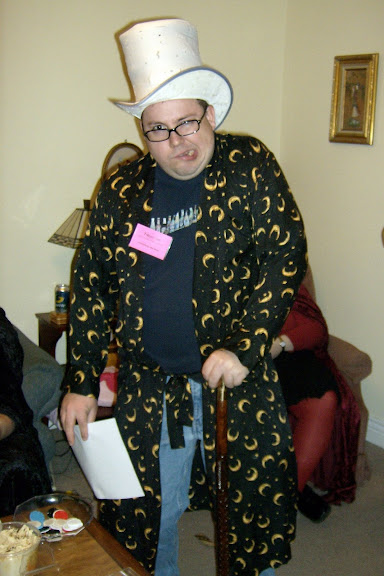
Those not present might want to see what the event looked like. Or those present might wish to see how embarrassing they look dressed as a superhero. Either way, readers might wish to see the photos from the February LARP. The only people likely to be disappointed would be those looking for photos of either GM. Amber was busy taking said photos, so does not appear in them. I meanwhile, am apparently some sort of vampire or other soulless abomination that does not show up on film.
Few of the photos are action shots, because during action-y times a GM is busy doing other things. So I don't know if it gives an accurate depiction of the LARP. But it'll give you an idea what the bottom rungs of the superhero society look like.
Subscribe to:
Posts (Atom)

